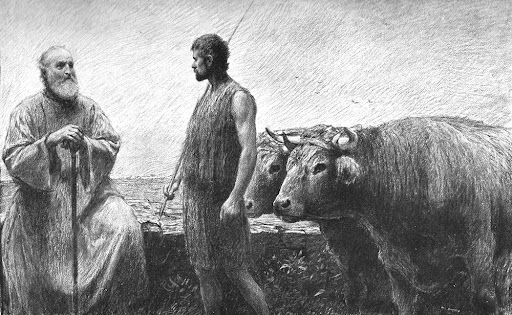
The Dishonest Manager, #17

eugene-burnand.com/

Luke 16:1-9, ESV

“There was a rich man who had a manager, and charges were brought to him that this man was wasting his possessions. And he called him and said to him, ‘What is this that I hear about you? Turn in the account of your management, for you can no longer be manager.’ 

And the manager said to himself, ‘What shall I do, since my master is taking the management away from me? I am not strong enough to dig, and I am ashamed to beg. I have decided what to do, so that when I am removed from management, people may receive me into their houses.’” 

“So, summoning his master’s debtors one by one, he said to the first, ‘How much do you owe my master?’ He said, ‘A hundred measures[a] of oil.’ He said to him, ‘Take your bill, and sit down quickly and write fifty.’ Then he said to another, ‘And how much do you owe?’ He said, ‘A hundred measures[b] of wheat.’ He said to him, ‘Take your bill, and write eighty.’” 

The master commended the dishonest manager for his shrewdness. For the sons of this world[c] are more shrewd in dealing with their own generation than the sons of light. And I tell you, make friends for yourselves by means of unrighteous wealth,[d] so that when it fails they may receive you into the eternal dwellings.”

This one’s a challenge. I’ve wrestled off and on with this passage for 40 years, and until just lately have I’ve gotten an idea, (maybe) of what this parable is about. (If I’m off the wall, please let me know.) I must say, first of all, that the dishonest manager’s trickery is never endorsed by Jesus. The man is a thief and a scoundrel. He has embezzled his master’s money, and betrayed his trust. That’s a bad thing.

But yet there is something worth emulating about his conduct.

He’s a genuine businessman–focused and direct. He’s always got a plan, he’s always thinking ahead. He has a definite direction. There’s a purpose and a direct idea–a focus, and that sets him apart from others. Jesus makes an observation to his disciples. It’s the key to this parable. Notice what I’ve highlighted:

8-9 “Now here’s a surprise: The master praised the crooked manager! And why? Because he knew how to look after himself.” “Streetwise people are smarter in this regard than law-abiding citizens.”

“They are on constant alert, looking for angles, surviving by their wits. I want you to be smart in the same way—but for what is right

—using every adversity to stimulate you to creative survival, to concentrate your attention on the bare essentials, so you’ll live, really live, and not complacently just get by on good behavior.”

Luke 16:8-9, Message

A sailor will tell you that the hardest boat to steer is one that is dead in the water. Perfectly still it can’t be directed. It has to be moving. I wonder sometimes if some of Jesus’ disciples are too passive. They’ve repented and experienced God’s grace; they are definitely saved and going to heaven. That’s wonderful. But they’re just stalled after that. They have become passive and unfocused. They seem to float and drift and take whatever current that moves them along.

That “dead in the water” passivity isn’t what Jesus is looking for. This parable stresses the need to be aware, alert and always “looking for angles.” People like this have an edge about them, they’re like the salesman in a leisure suit– they’re always focused on their next “lucrative” move. They’re the “hustlers” of the Christian walk!

Jesus made an observation about that same sort of intensity in the ministry of John the Baptist:

“The Law and the Prophets were until John; since then the good news of the kingdom of God is preached, and everyone forces his way into it.”

Luke 16:16

There needs to be a holy violence, it seems, something that’s pressing–something we’re striving for. Paul understood this also:

 “I press toward the mark for the prize of the high calling of God in Christ Jesus.”

Philippians 3:14, KJV

Jesus is making it quite clear that a passive walk is contrary to true discipleship. There must be movement towards a goal. We can’t just float through a nice, quiet Christian life. There needs to be a zeal and a holy direction. Yes, we need to wait, and listen! Being still and quiet before him is critical. But we can’t lose our direction and focus. It seems we must be forceful.

I believe that this parable reveals to us that a holy zeal is needed. The dishonest manager was a rascal and a cheat. But yet there was something that Jesus approved of, a directed zeal for that which we should have. Perhaps we’ve gotten a bit lax–floating through our salvation without any direction.

We definitely need to be people who love, and who are controlled by the Spirit. But we also need to be a people who press into the things of God. We need a directed zeal and definite purpose. Being a passive believer isn’t an option, and it doesn’t please God. We need to become believers who are always looking at God’s glory, and are moving toward it with a holy zeal, and a specific purpose.

“Men could be content to have the kingdom of Heaven; but they are loathe to fight for it. They choose rather to go in a feather bed to Hell than to be carried to Heaven in a ‘fiery chariot’ of zeal and violence.”

    Thomas Watson

Art by Eugène Burnand

Take the Lowest Place, #16

Luke 14:7-11, CSB

He told a parable to those who were invited, when he noticed how they would choose the best places for themselves: 

“When you are invited by someone to a wedding banquet, don’t sit in the place of honor, because a more distinguished person than you may have been invited by your host. The one who invited both of you may come and say to you, ‘Give your place to this man,’ and then in humiliation, you will proceed to take the lowest place.”

10 “But when you are invited, go and sit in the lowest place, so that when the one who invited you comes, he will say to you, ‘Friend, move up higher.’ You will then be honored in the presence of all the other guests. 11 For everyone who exalts himself will be humbled, and the one who humbles himself will be exalted.”

Choose your seat carefully. In Jesus’ day, there was a definite seating order to a wedding feast. It wasn’t first come, first served. There was a strict protocol, where one’s importance mattered. Honored people got honorable seats–close to the front as possible. Average people got average spots; but no one wanted be at the bottom, having to sit at the “kids table.”

Jesus was watching, and he what he saw was a spiritual principle of his Kingdom.

Jesus often teaches out of the things we encounter–real life events. Spiritual truth often hits us from those things we actually see. If you want to know what God is doing in your life, all you need to do is look around at the “practical” things, and start to see the spiritual lessons inside them. We learn from real-life. That’s how he often teaches us, he combines the Word with what we’re experiencing.

Our natural inclination is to move higher up. We often think that we’re deserving, and so we take our “rightful” positions. That’s the way humans think. We all want to sit in the best possible place, and so we end up wheedling our way up front. We can fall into the subtle trap of self-promotion. But that’s not how discipleship works.

Jesus corrects, advising us to take the lowest place. I think verse 11 is the key to figuring out this seating arrangement. We’re starting to see a physical situation become a spiritual lesson. There’s much to learn. Here’s verse 11 in the Amplified version:

“For everyone who exalts himself will be humbled [before others], and he who habitually humbles himself (keeps a realistic self-view) will be exalted.”

This translation injects some realism into our lives, especially in how we see ourselves. It’s something quite foundational. It lays down a principle that is always true in his Kingdom (1 Peter 5:6). If we don’t accept and implement this, we’ll suffer a definite deficiency in our discipleship. It stunts the growth of many believers. And that is tragic.

The whole scene lays out how life in the spirit really works, and it seems terribly paradoxical.

Our human logic asserts that deliberately choosing the lesser is foolish, things really don’t work that way. We think, (falsely,) that we’ll only advance by asserting ourselves. But Jesus, quite aptly, clarifies the ways of the Kingdom–true maturity will only come if we decide to take the lowest place.

“Humble yourselves before the Lord, and he will exalt you.”

James 4:10

The Parable of the Midnight Request, #15

Luke 11:5-8, CSV

“He also said to them, “Suppose one of you has a friend and goes to him at midnight and says to him, ‘Friend, lend me three loaves of bread, because a friend of mine on a journey has come to me, and I don’t have anything to offer him.’ Then he will answer from inside and say, ‘Don’t bother me! The door is already locked, and my children and I have gone to bed. I can’t get up to give you anything.’ 

I tell you, even though he won’t get up and give him anything because he is his friend, yet because of his friend’s shameless boldness, he will get up and give him as much as he needs.”

This parable is known by some as “the Importunate Neighbor.” That’s an excellent description. Importunate is defined as being persistent, especially to the point of annoyance or intrusion. It’s tenacious and stubborn–not giving up even when being ignored. That describes what’s happening here.

What proceeds this parable is Luke’s version of the Lord’s prayer, which the disciples requested. They wanted to understand the methods and mechanics of praying–perhaps the Pharisee’s prayers weren’t quite up to snuff–they wanted more; and they insisted that Jesus instruct them. They wanted to do it right.

A typical Jewish home had sleeping quarters (one room!) located on a raised platform. A ladder was used to access that level (which could be crowded, sometimes two to a bed.) Often their livestock were brought inside. And when it was time to get up, everyone got up. That explains the homeowner’s reluctance to give bread to his neighbor. To get up, light a lamp, wasn’t a solitary affair.

He’s obviously unenthusiastic to make an effort.

The word used here to explain the neighbor actions is ἀναίδεια “anaídeia,” which is only ever used here–it’s translated as impudence, shamelessness, audacity or “chutzpah.” It’s a Greek word that explains the knocker’s rudeness. He won’t stop. He knocks and pounds until he gets his bread. Not to have bread for his guest is unheard of, it violates the unwritten law of Jewish hospitality. 

This is part of Jesus’ view on prayer. It means we must be inappropriate sometimes–even to the point were we are being rude.

Immediately following this parable (the very next thought) are the following instructions:

“So I say to you, ask, and it will be given to you. Seek, and you will find. Knock, and the door will be opened to you. 10 For everyone who asks receives, and the one who seeks finds, and to the one who knocks, the door will be opened.”

Luke 11:9-10

Perhaps it’s this intensity that’s lacking.

We “pray” but don’t insist. We desire but don’t demand. Maybe it takes a certain shamelessness to make prayer work. Jesus emphasizes a necessary component to praying God’s way. It’s never automatic, a simple phrase or two that moves the father’s heart, and loosens his hand. In Jesus’ teaching, prayer means effort.

“There is neither encouragement nor room in Bible religion for feeble desires, listless efforts, lazy attitudes; all must be strenuous, urgent, ardent. Flamed desires, impassioned, unwearied insistence delight heaven. God would have His children incorrigibly in earnest and persistently bold in their efforts. Heaven is too busy to listen to half-hearted prayers or to respond to pop-calls. Our whole being must be in our praying.”

    E.M. Bounds

f

Art by Eugène Burnand

An Unworthy Servant, #14

Luke 17:7-10

“Which one of you having a servant tending sheep or plowing will say to him when he comes in from the field, ‘Come at once and sit down to eat’? Instead, will he not tell him, ‘Prepare something for me to eat, get ready, and serve me while I eat and drink; later you can eat and drink’?” 

“Does he thank that servant because he did what was commanded? 10 In the same way, when you have done all that you were commanded, you should say, ‘We are unworthy servants; we’ve only done our duty.’”

“The will of God for your life is simply that you submit yourself to Him each day and say, “Father, Your will for today is mine. Your pleasure for today is mine. Your work for today is mine. I trust You to be God. You lead me today and I will follow.”

    Kay Arthur

Really now. What little we give determines so much, since we owe him so much. The service that we can give to our master is just a small repayment for everything. Settle that now and God will use you.

Question: Is the master unfair? Does he lord his authority over the servant–taking advantage of him? Every time I read this passage, questions like this always comes up.

#1, the Holy Spirit really hasn’t taught me yet. That’s very possible. Until he does, the parable isn’t truly understood.

#2, I’m a product of my country, no such things like slaves, we’re a democracy. Equal rights and all that jazz.

#3, It’s purposefully constructed to create issues in my mind and heart. Something that “irritates” me–but in a good way.

And maybe they’re all true. But no matter how I “squeeze” out this parable, I always hit this spiritual speed bump. But I like it, and I love reading it, no matter what it does to me.

We owe everything to him. Plain and simple.

Jesus wants to be my master. I’m his servant (at least I really want to be). Reading this parable puts this idea into a real perspective. I do like this verse, 1 Corinthians 6:20, in the CEV:

“God paid a great price for you. So use your body to honor God.”

A transaction has been made for your soul. God has intervened, and he’s given you salvation. We have a life now that will give us life, eternally. Since he is our master, we can no longer direct our own lives. Like the “unworthy servant” in verse 10, we now walk forgiven and very much redeemed. And we owe it all to him, he’s our savior and our master.

“The question in salvation is not whether Jesus is Lord, but whether we are submissive to His lordship.”

   John MacArthur

y

r

Art by Eugène Burnand

On the Rock, #13

Matthew 7:24-26, NCV

“Everyone who hears my words and obeys them is like a wise man who built his house on rock. 25 It rained hard, the floods came, and the winds blew and hit that house. But it did not fall, because it was built on rock. 26 Everyone who hears my words and does not obey them is like a foolish man who built his house on sand.”

Embedded in Jesus’ Sermon on the Mount, are these words: they absolutely penetrate any “religious” sensitivity we think we have. This parable Jesus taught carries the full weight of divine authority. Up to now, Jesus’ listeners just might reduce his words to nice religious platitudes–something future, and maybe conceptual. I must warn you, this isn’t the case.

Obedience is the critical idea here. If they’re wise, they are told to put all they’ve heard into practice. It’s really not enough to hear and respect what Jesus declares–they must do the words. Jesus isn’t simply a great moral teacher, all that he says is authoritative; and not just in a benevolent, superficial way–what he says are the very words of God to people, like you and I.

There are two builders in this parable. Two different men; the wise and the foolish.

The each have their own strategies, their methods are quite different. Both listen; but one responds with careful planning. He understands the potential dangers–rain, floods and wind are going to happen. It’s funny, our Lord never “sugarcoats” life. Nasty things are going to happen, weather that’s quite hostile. Following Jesus never gives us any immunity; there are no special favors given to a believer. (Only comfort.)

The other (Jesus addresses him as foolish) are those who’ve decided to take a shortcut in all of this construction stuff. Maybe it takes too much time? But he decides to implement the work as soon as he can. Maybe his motive is just wanting to put Jesus’ words into practice. Maybe (just my conjecture) he feels compelled to initiate Jesus’ teachings as soon as he can? Maybe he’s got a noble reason in this? (In God’s kingdom however, I’ve learned that there aren’t any instant breakfasts on the menu.)

Obedience is mentioned twice. Enthusiasm is never mentioned; eagerness in all of this is not good spirituality it seems. Careful work (and planning) are critical issues. This is just an example–Matthew 5:3 is the first Beatitude:

“They are blessed who realize their spiritual poverty,
    for the kingdom of heaven belongs to them.”

How diligent are we putting this into effect? Do we just slap it down and move to the others as quickly as we can? Many commentators refer to the Beatitudes as the “foundation stones” of the disciple’s life. Many believe that each one builds off the other–they compliment and support each other. Sometimes I wonder about my own foundation; am I laying it right, and level?

I want to stress that your take your time laying down his words. Examine carefully what he’s telling you about your construction. He’s our true Architect–we are only the builders. We read his plans, examine his blueprints. We really need to be faithful.

“Using the gift God gave me, I laid the foundation of that house like an expert builder. Others are building on that foundation, but all people should be careful how they build on it.”

1 Corinthians 3:10

Be diligent in these matters; give yourself wholly to them, so that everyone may see your progress.”

1 Timothy 4:15

The Old & The New Wineskins, #12

Matthew 9:16-17, LB

16 “And who would patch an old garment with unshrunk cloth? For the patch would tear away and make the hole worse. 17 And who would use old wineskins to store new wine? For the old skins would burst with the pressure, and the wine would be spilled and skins ruined. Only new wineskins are used to store new wine. That way both are preserved.”

Some might suggest that Jesus came to bolster up the old covenant, to rehabilitate Judaism and to bring it back in alignment with God’s will. This wasn’t the plan of the father. Jesus understood that he didn’t come to repair or reform the old, but to institute the new. That which is old and stagnant could never be made new and fresh.

The kingdom of God was to be something the world had never seen before. Jesus adeptly uses two illustrations to declare what the Holy Spirit was now doing. Patching up the old with something new that wouldn’t ever work, a tear would happen. And to pour fresh wine into something old could never handle the pressure of the new–that would be the height of foolishness.

The Pharisees’ and the scribes were hanging on to Jesus’ every word (and you’d better believe it.) They suddenly understood the threat of his Kingdom had on their own initiative. And these guys were scared; they were threatened by the coming of this new thing. These men were counting on “tradition” to preserve the order of things. They were old wineskins.

I’m thoroughly convinced that God is always up to something that’s totally brand new. Throughout history we see him show up on the scene with things that challenge his believers even further. He’s always had new things up his sleeves. He’s always faithful and true, no question about that. But he’s always been creative and busy in our present-day lives.

“Behold, the former things have come to pass, Now I declare new things; Before they sprout I proclaim them to you.”

Isaiah 42:9, (43:19; 46:9-10).

The real challenge is whether we can keep up with what he’s doing. He’s the “I am,” not the “I was” or what “I will be.” He’s present in this “now” moment! And if that’s true, I out to get a grip. To solidify isn’t the answer.

So what does this really mean? Perhaps, I suppose, I’m to think that the Holy Spirit is full of amazing and incredible surprises!

He’s always moving the goal posts, pulling us along with him. To be honest, I’ve changed dramatically in the last 30 years as a Christian. I think I understand more about the Father than I did in July 1982. (And sometimes, it seems like I know him less.)

I once got trapped in a “rip tide” off of a beach in Mexico. It dragged me along with it, and I couldn’t escape it. The current was pulling,, and I remember flailing against it; but no matter how much I fought and struggled I couldn’t resist the pull. Perhaps that’s how the father’s kingdom works. His spirit is never still or stagnant. He tugs on us, so we must follow him, if we’re going to be obedient.

Our king is moving. We must follow Him.

Scripture tells us that his kingdom is always growing, (Matthew 13:31-33.) He is always faithful and consistent to his people, but yet he’s also always taking us somewhere else. Abraham, Moses, the Jewish exodus all tell us he loves to stretch out his servants this way. Discipleship means following, not sitting under a nice tree, we’ve become brand spanking new—whether we like it or not, (2 Cor 5:17.)

The Bible is full of revival, and renewal, but God refuses to simply re-educate and legislate us to do his will. Rather he re-makes us. We WALK by faith (always steadily moving) and being a pilgrim means we never get to camp out in a nice, comfortable spot. He’s always leading, and I’m always following.

“For he was looking forward to the city that has foundations, whose architect and builder is God.”

Of Moses, (Hebrews 11:10)

a

y

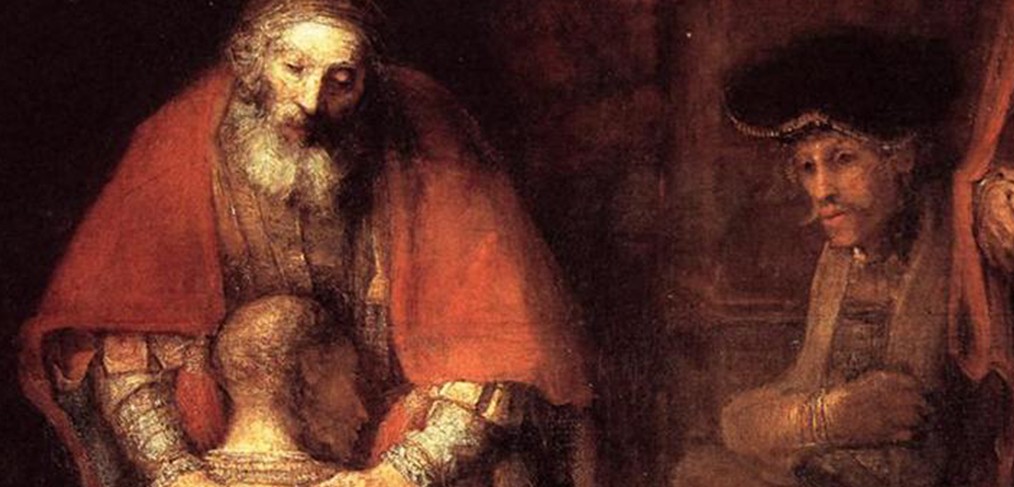
A Father Who is Running, #10c

The Father Runs

Luke 15:20-24, (part three of four)

20 “And he arose and came to his father. But while he was still a long way off, his father saw him and felt compassion, and ran and embraced him and kissed him. 21 And the son said to him, ‘Father, I have sinned against heaven and before you. I am no longer worthy to be called your son.’”

22 “But the father said to his servants, ‘Bring quickly the best robe, and put it on him, and put a ring on his hand, and shoes on his feet. 23 And bring the fattened calf and kill it, and let us eat and celebrate. 24 For this my son was dead, and is alive again; he was lost, and is found.’ And they began to celebrate.”

“Cursed is the man that feeds the swine.” That’s the commentary on Jewish ritual cleanness. The prodigal knew this, but when you’re starving, tradition is thrown out the window. It’s really hard to be spiritually correct when your stomach is growling. In verse 17, we see that the prodigal suddenly realized his condition. Notice the change:

It took sometime for this to happen. But it was a true and a complete repentance. A total alteration of his mind and heart took place at that point. And I must assume, when he finally made the decision to return, he didn’t even say ‘good bye’ to the pigs.

It’s the Father’s reaction that fascinates me.

How does God see us? Is he angry or frustrated? And yes I suppose, there is ample reason for him to treat us with caution. Deep down, we know exactly how dark we are, and on a superficial level we realize our dirt doesn’t belong in heaven. And yet the father is in a party frame of mind. That isn’t rational.

And there were no tests given to evaluate the son’s sincerity. Did he really repent, or was it all for show? The text tell us that he was hungry, maybe he just wanted a hand-out? Did he meet the criteria needed for reinstatement? It amazes me, there wasn’t a 30 day waiting period to determine whether the prodigal had truly repented. No, the party started when the father hugged his son.

Do you see the “suddenness” of this part of the story?

At least for me, the pace quickens, and I imagine the whole household jumped up to get in the act. Verse 10 explains the joy that reverberates through heaven at this, Just so, I tell you, “there is joy before the angels of God over one sinner who repents.”

Joy seems to be the key thought to really “get” these verses. If we can’t see it saturate (like a sponge) we’ll never understand this parable. Its not hard if you can read it with excitement and anticipation. If you decide to do so, it’ll make a lot of sense, and it’ll be less mysterious.

This story is as much about the father as it’s about the son.

In it we see the character of the Father revealed. We see his joy, and excitement over his son’s return. Right from the start we see him running, (v. 20) moving to his son. I can see a weeping father giving his son a big bear hug and lots of kisses. He has hoped and dreamed about this moment.

Golly, there is so much to be said: there’s rings and shoes and roasted calves. But I think that the tremendous lesson is the joy of the father. It tells me much about what he’s like–and he’s not at all what I thought he’d be.

He’s the Father who is always moving, and he runs to meet us. He’s the One who is filled with joy at our return. And honestly, aren’t we always returning?

a

..

The Insanity of Sin, and the Prodigal Son, #10b

Luke 15:14-19, (Part two of four)

14 And when he had spent everything, a severe famine arose in that country, and he began to be in need. 15 So he went and hired himself out to[a] one of the citizens of that country, who sent him into his fields to feed pigs. 16 And he was longing to be fed with the pods that the pigs ate, and no one gave him anything.

17 “But when he came to himself, he said, ‘How many of my father’s hired servants have more than enough bread, but I perish here with hunger! 18 I will arise and go to my father, and I will say to him, “Father, I have sinned against heaven and before you. 19 I am no longer worthy to be called your son. Treat me as one of your hired servants.”’

“The hearts of the sons of mankind are full of evil, and insanity is in their hearts throughout their lives.”

Eccl.9:3

Insanity is an irrational belief in something that isn’t true; it’s a severely disordered state of the mind, often sometimes even a form of psychosis. This is how the world operates. It’s part of a deep confusion that doesn’t accept the reality of God. It has taken up the darkness repeatedly, so it walks in darkness now, a chosen blindness that can’t see the realities of the gospel.

“In their case, the god of this age has blinded the minds of unbelievers to keep them from seeing the light of the gospel of the glory of Christ.”

2 Corinthians 4:4

The youngest son demanded his share of the inheritance immediately. This was unheard of, one would never done this in biblical times–it was as if the father was already dead. The youngest son insisted on his share, without question. He wanted everything that was coming to him. The insanity of sin is that it causes darkness; it grows into madness.

However, the prodigal is never judged by the father.

One of more amazing facts is the son was never corrected for his irrational behavior. Perhaps the father knew what would happen to him, and rested in that understanding. The younger son would learn the hard way. The father understood, but being a father isn’t always easy.

The son spent it all, everything that had been given to him. There was nothing left. He was hungry–starving, but he didn’t have a penny to buy bread, in this passage we see that he took a job with the local pig-keeper–and a good Jewish boy would never have dreamed that this was his destiny.

Hunger had done its work.

If you’ve ever gone hungry for any length of time, you know what that means. The scripture tells us, “he came to his senses.” He suddenly realizes that even the father’s servants have more than he has. He choses to leave the pigs, and return home to his father.

“Father, I have sinned.” and with this truth he finally understands.

He realizes that his disobedience has led him into a big fat lie. He has betrayed his father, and we start to grip this thought, we immediately realize that every cent he had bought booze and whores. He has nothing–maybe less than nothing. And he’s starving and quite willing to eat the pig’s food.

All of this rolls over him, and he finally connects with reality.

The prodigal finally gets it. He must return to the father, even if he becomes a slave. (Even they if he finds food to eat.) He has less than nothing–the choice he makes is obvious. He’ll return, even if it means servitude to his father. At least, his hunger pains will not be an issue.

That’s the insanity of sin.

It develops and we see it in Jesus’ story. If we’re irrational, we’ve left behind the reasonable, and we’ve embraced lies. He does exist, or so we’ll try to convince ourselves. And yet we continue, over and over, to want the false, over the truth, and the question is why? Could it be, that sin has altered our thinking?

The son is no longer walking in deception–he finally gets it. He understands, to be the slave of his father is something that’s worth it all. To be rescued from the pigs is what he can only dream about.

He leaves the darkness and chooses to step into the light.

d

The Story of a Lost Sheep, #8

On a warm afternoon, a lamb takes a peek at a visitor while eating hay at Fat Rooster Farm in Royalton, Vt., on April 27, 2003. (Photo by Geoff Hansen)

Luke 15:1-7

 “All the tax collectors and sinners were approaching to listen to him. And the Pharisees and scribes were complaining, “This man welcomes sinners and eats with them.”

So he told them this parable: “What man of you, having a hundred sheep, if he has lost one of them, does not leave the ninety-nine in the open country, and go after the one that is lost, until he finds it? And when he has found it, he lays it on his shoulders, rejoicing. And when he comes home, he calls together his friends and his neighbors, saying to them, ‘Rejoice with me, for I have found my sheep that was lost.’ Just so, I tell you, there will be more joy in heaven over one sinner who repents than over ninety-nine righteous persons who need no repentance.

What does it mean to be lost? All of us have that much figured out by now–and if not, we will. The Bible nails us with this particular story, and it rings very true of the human condition. You don’t need a PhD in Psychology to understand this. The heart and soul of a man, a woman is in the awful state of separation, and for some of us–we understand. For others, the clock is ticking.

Let’s face it, the Pharisees and the scribes have issues. Their whole belief system–the idea of who’s righteous and who’s not, is being rocked. The sinners are coming to listen to Jesus (maybe for the stories, maybe for something else?) The religious regime is mystified, and maybe a bit jealous. Perhaps they were irked at the grace of God they see in Jesus?

Jesus tells a story, (and he loves to tell stories I’ve found.) Anyway, the parable he shares is 100 words (more or less) and it describes the condition of every man, woman, and child–everyone who has ever existed. He clearly cuts through “religion” like a hot knife through cold butter. He quite succinctly describes us. And wow, these stories are eye-openers.

We’re all lost sheep–wandering, and very confused.

The paths we’ve taken to get out of our “lost-ness” have only confused us even more. We’ve had to deal with thorns and vultures; it hasn’t been easy, and we’ve never been able to reconnect to safety. Some become “smart” people, others buy fast cars, some kill their lost-ness with booze or drugs. We find many different ways to keep us from feeling this separation from God.

A very lost sheep. In Luke 15, we find three parables that all deal with lost things–sheep, coins, and sons. Essentially, they each explain things; they’re very aware. Most of us know that the religion of the Pharisees hasn’t worked. Even the sinners understand that much. Sometimes even the very lost have figured that much out, even before the so-called righteous do. Some of us need to listen closely to sinners, and to stop listening to religious people.

Jesus tracks us down–our confusion has finally enabled us to finally see his outstretched arm. The Father has this odd preference for those who know they’ve lost, and these three parables come in a deliberate succession–that should make things pretty clear.

So dear one, will you insist on wandering? Is that what you really want?

w

Good Fish, Bad Fish, #7

47 “Again, the kingdom of heaven is like a large net thrown into the sea. It collected every kind of fish, 48 and when it was full, they dragged it ashore, sat down, and gathered the good fish into containers, but threw out the worthless ones. 49 So it will be at the end of the age. The angels will go out, separate the evil people from the righteous, 50 and throw them into the blazing furnace, where there will be weeping and gnashing of teeth.”

Matthew 13:47-50, (context, vv. 47-52)

There will be a separation, the scripture is painfully clear. This division can also be seen in the Parable of the Wheat and Tares. In both stories, we see this splitting-up of the authentic and the false. The saved and unsaved. They’ll never be mixed, they’re like oil and water.

In this parable, a dragnet (a net that scrapes the bottom) collects all the fish. Apparently none escape. The net is finally dragged up on the beach, and people begin the sorting process. This really has to be done.

Jesus has captured us.

Here in Alaska, I had the wonderful chance to work in a cannery. There was an automated line where a bunch of us stood. (Believe me when I tell you it was hard and mindless work.) We picked out the fish that didn’t belong, and only the good were crated up. These were flash-frozen for their trip to Japan. The bad fish were ground up (if I remember correctly) and dumped. The seagulls loved it.

In this parable, we see precisely the same kind of separation.

There was no wholesale acceptance of every fish. The “quality control” guys looked over the sorter’s work, they made sure that every fish ended up where it was supposed to go. There couldn’t be any mistakes. I suppose if anything, the whole process might be called “discernment.” Distinctions were made by the type (or nature) of every fish that came on the line.

There can be no mixture in the Kingdom of God.

Oil and water, even if you shake it–really, really hard, you still can’t get them to blend. Apparently, they’re of different densities (I assume anyway) and they won’t merge or mingle. That’s a fact.

There’s coming a time, Jesus said, that there will be a reckoning, a summation. The Kingdom of God won’t come as a party for everyone. We’re pretty much warned of that ahead of time. This is going to happen, you can mark it on your calendar. Jesus shared this story, and it doesn’t entertain us like some of the other parables he shared. It’s meant to sober us up, and it’s given to help us choose, and prepare.

We have been warned.

u